

+91 98209 33660
Directly sourcing high-efficiency crossflow blowers tailored for German OEM machinery, HVAC air curtains, fireplace heating, thermal enclosures, and industrial drying systems.
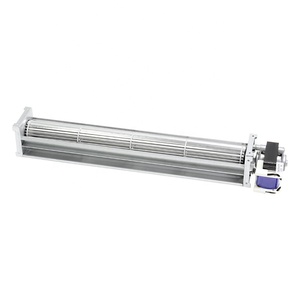
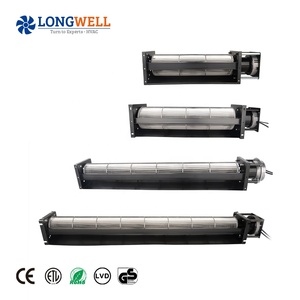
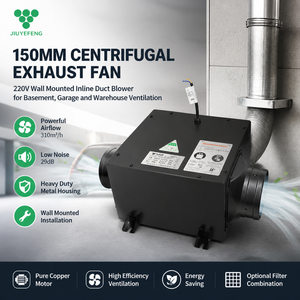
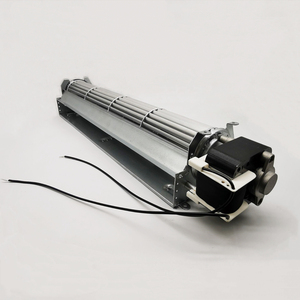
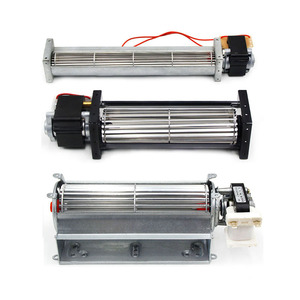
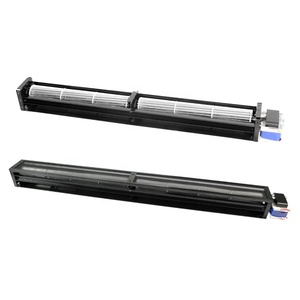
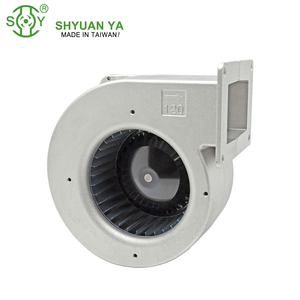
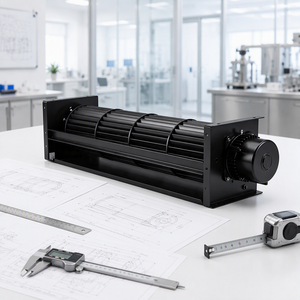
Crossflow blowers (also designated as tangential fans) occupy a distinct aerodynamic classification within industrial fluid dynamics. Unlike axial fans—which generate displacement parallel to the rotational shaft axis—or centrifugal blowers—which intake air axially and discharge radially at a 90-degree vector—the crossflow blower establishes a two-dimensional transverse flow field. The air enters the cylindrical multi-blade impeller on one side of the perimeter, passes through the interior core space, and is accelerated outward through the opposite side of the periphery.
The operational core of a high-performance tangential blower relies on the generation of an eccentric, longitudinal vortex (often referred to as a "vortex core" or *thoma vortex*) that forms parallel to the rotor axis. This localized low-pressure vortex continuous stabilizes the air stream, guiding it seamlessly across the blade cascades. As a direct result, crossflow fans deliver a remarkably uniform, rectangular, laminar air curtain characterized by low turbulence, high linear air velocity, and minimal acoustic signature—making them irreplaceable for applications where broad spatial airflow coverage and restricted mounting depth are paramount.
Engineering Benchmark: High-efficiency tangential blowers engineered for the German market must maintain precise geometric tolerances between the vortex wall tongue (Vortex-Zunge) and the impeller blade tips. A clearance deviation of merely 0.5mm can increase acoustic emissions by up to 4.2 dB(A) under system pressure loads.
The static pressure recovery ($\Delta p_{s}$) and total dynamic head produced by a tangential impeller are governed by the Euler turbomachinery equations customized for transverse vortex dynamics. Because the fluid passes through the blade row twice (inward intake and outward discharge), energy transfer occurs in two distinct stages:
P_total = \rho \cdot u \cdot (v_{u2} - v_{u1}) + \Delta p_{vortex}
Where $u$ represents peripheral blade velocity, $v_{u}$ denotes tangential component of absolute fluid velocity, and $\Delta p_{vortex}$ accounts for the static pressure differential sustained across the stabilized internal vortex core. For German OEM equipment builders (Original Equipment Manufacturers in Maschinenbau and Klimatechnik), selecting the optimum combination of forward-curved blade angles ($\beta_1, \beta_2$), impeller length-to-diameter ratio ($L/D$), and housing scroll profile is essential to achieving maximum volumetric flow efficiency ($\eta_v > 68\%$).
Tailored thermal and air movement engineering solutions complying with stringent DIN, VDE, and EN safety regulations across Germany, Austria, and Switzerland.
In accordance with DIN EN 13779 indoor air quality norms, German commercial retail and logistics hubs utilize dual-impeller EC tangential blowers to project high-velocity thermal air barriers across entrance doorways. This prevents winter heat loss and suppresses cold drafts, reducing facility HVAC energy expenditure by up to 34%.
German residential heating brands demand Class H insulated (up to 200°C) crossflow blowers integrated with high-efficiency PTC heating elements. Operating continuously to radiate uniform convective heat across living spaces while retaining an acoustic sound pressure level strictly below 28 dB(A) at 1-meter distance.
High-density automation enclosures, Siemens S7 PLC racks, and industrial inverter cabinets require uniform vertical air sweeps to eliminate localized thermal hot spots. Low-profile 45mm and 60mm DC crossflow blowers fit narrow 19-inch rack slots without consuming valuable component DIN-rail space.
Laboratory biological safety cabinets and pharmaceutical filling lines utilize zero-vibration crossflow blowers to maintain laminar ISO Class 5 air flow. The steady air velocity profile prevents cross-contamination and ensures compliance with strict European Health & Safety standards.
Supermarket display cases (Kühlregale) rely on IP55-rated waterproof DC tangential fans to continuously circulate cold air across glass doors. Preventing condensation buildup while operating under high humidity and sub-zero temperature environments.
Fast-charging DC stations (150kW–350kW) demand forced convection thermal management. Stainless steel double-impeller tangential blowers deliver continuous, weatherproof heat extraction for high-power liquid-cooled transformer units.
The European Union's regulatory landscape for industrial ventilation and HVAC machinery is undergoing rapid tightening. For German procurement officers (*Einkaufsleiter*) and chief technology officers (*Chefingenieure*), sourcing crossflow blowers from Chinese manufacturers requires absolute compliance alignment with the following key directives:
| Performance Parameter | Traditional AC Shaded-Pole Blower | High-Efficiency EC Tangential Blower | German Market Advantage |
|---|---|---|---|
| Electrical Efficiency ($\eta$) | 18% – 28% | 60% – 72% | Complies with EU ErP Tier 2 Directives |
| Speed Modulation | Single/Dual Tapped Winding | Continuous 0-10V / PWM / Modbus | Smart BMS & Industry 4.0 Integration |
| Motor Thermal Operating Temp | Class B (130°C) or Class F (155°C) | Class F (155°C) or Class H (200°C) | High Overload & Extended Service Life |
| Bearing System Life ($L_{10}$) | 15,000 Hours (Sleeve Bearing) | > 50,000 Hours (Dual Ball Bearing) | Zero Maintenance over 6+ Years Continuous Run |
| Acoustic Signature | Tonal Humming at 50Hz Grid Freq | Ultra-Quiet, Asymmetric Pitch Blade | Meets German Noise Limits (DIN 45635) |
Combining over 50 years of electrical motor manufacturing heritage with state-of-the-art automated testing and customization capabilities.
Every aluminum alloy impeller undergoes two-plane computerized dynamic balancing to grade G2.5. Eliminating shaft vibration, preventing premature bearing fatigue, and ensuring silent rotation.
From high-speed silicon steel stamping presses to precision aluminum blade extrusions, our total vertical integration guarantees batch-to-batch consistency and fast OEM prototyping within 14 days.
We engineer custom shaft extensions, mounting flanges, rubber anti-vibration dampers, thermal overload protectors (Thermocontact / Klixon), and customized lead wire terminations (WAGO/Molex/TE).
CNC multi-axis copper coil winding machines combined with automated varnish dipping ensure optimal slot fill factor, superior dielectric insulation strength, and high thermal heat dissipation.
Equipped with an AMCA 210 compliant wind tunnel chamber, soundproof acoustic testing room, and environmental temperature/humidity test chambers to deliver certified P-Q performance curves.
Established DDP/CIF shipping channels to major German hubs (Hamburg, Bremerhaven, Frankfurt, Duisburg). Full customs clearance handling with complete CE/RoHS compliance certificate packages.
Technical, regulatory, and commercial answers for German engineers, purchasers, and distributors.
Request our complete 2024 Product Catalog, engineering 3D CAD files, or schedule a technical consultation with our senior aerodynamic design team today.