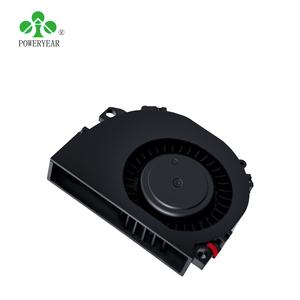
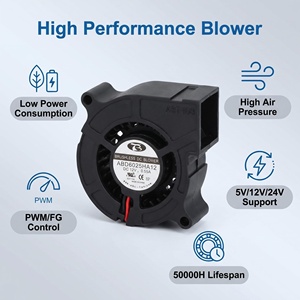
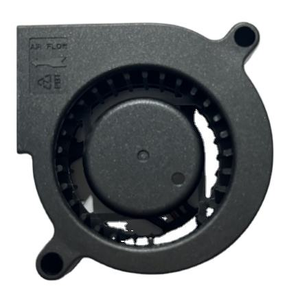
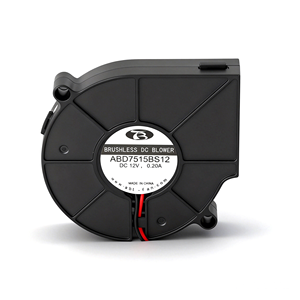
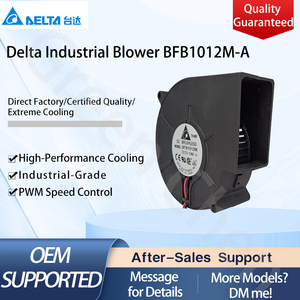
Poweryear 5010 High Speed Brushless 50mm Turbo Blower Fan DC 5V 12V 24V
- Dimensions: 50x50x10mm
- Voltage: DC 5V / 12V / 24V
- Bearing: Dual Ball / Sleeve
- Application: Micro Cooling & Electronics
Explore our flagship range of brushless DC, high-efficiency EC, and heavy-duty AC radial fans custom-engineered for OEM equipment, 3D printers, HVAC systems, and extreme industrial environments.
With over five decades of continuous industrial motion and thermal engineering heritage, we operate state-of-the-art production facilities optimized for precision dynamic balancing, high-temperature copper winding, and strict quality assurance.
As a leading China radial fan manufacturer, our engineering paradigm revolves around absolute mechanical consistency. Radial blowers operate under intense centrifugal stress; even a sub-milligram imbalance can introduce structural vibration, elevated acoustic noise, and premature bearing failure.
Every dynamic centrifugal impeller produced in our factory undergoes two-plane dynamic balancing adhering to ISO 1940 Grade G2.5 standards. We manage the entire lifecycle in-house—from initial CAD aerodynamic simulations and precision plastic injection molding to automated stator winding, vacuum impregnation, and locked-rotor electrical safety testing.
Whether you require custom mounting flange geometries, specific PWM tachometer wire harnesses, or specialized IP68 potting for high-humidity outdoor applications, our technical team turns engineering requirements into reliable volume supply.

Custom blade curvature (Forward vs. Backward Curved), scroll housing discharge angles, and housing depths calibrated precisely to your system airflow restriction curves.
Vacuum-epoxy encapsulated stators providing true IP68 liquid submersible protection, salt spray corrosion shielding, and high-vibration structural resilience.
High-grade Class F and Class H copper magnet wire windings rated for high ambient temperature operation up to +105°C without insulation degradation.
Selecting the optimal radial fan requires a complete understanding of static pressure development, volumetric air flow rates (CFM), motor efficiency curves, and acoustics. This guide breaks down the core physics for procurement officers and thermal engineers.
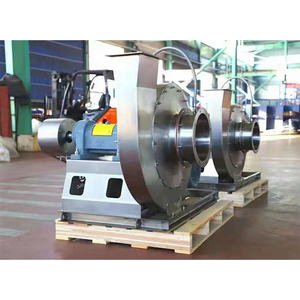
Unlike axial cooling fans that move large air volumes along the motor axis at low static pressure, radial fans (centrifugal blowers) pull air in axially and accelerate it outwards at a 90-degree angle. This centrifugal force converts kinetic energy into static pressure within the scroll housing.
This aerodynamic transformation makes radial fans the premier engineering choice when air must be forced through high-resistance internal pathways—such as HEPA filtration units, tightly packed electrical control enclosures, automotive seat ventilation channels, heat exchangers, and long ducted exhaust paths.
Operating a fan off its ideal performance curve can cause aerodynamic stall, elevated turbulence, and severe energy loss. Our factory engineering team assists OEM clients in plotting system impedance curves directly against our fan P-Q performance charts.
Use this matrix to determine the optimal radial impeller architecture based on your machine's mechanical layout, static pressure demand, and energy budget.
| Impeller Design | Static Pressure Capability | Airflow Efficiency (Total) | Acoustic Level | Dust & Particulate Handling | Primary Industrial Use-Cases |
|---|---|---|---|---|---|
| Forward Curved (FC) | Medium to High | 45% - 60% | Low (Smooth Air Flow) | Clean Air Only (Prone to dust accumulation) | HVAC Fan Coils, 3D Printers, Small Electronics Cooling Blowers |
| Backward Curved (BC) | High to Very High | 70% - 85% (Non-Overloading) | Very Low at Peak Efficiency | Moderate (Self-cleaning geometry) | EC Air Handling Units, Telecom Base Stations, Server Racks |
| Radial Blade / Paddle | Extremely High | 35% - 50% | High (Centrifugal Shear) | Excellent (Heavy dust, woodchips, fumes) | Industrial Fume Extraction, Material Handling, Vacuum Blowers |
| Radial Tip Impellers | High | 60% - 70% | Moderate | Good (Erosion Resistant) | Mining Ventilation, Commercial Dryer Air Circulation |
Global equipment manufacturers face growing regulatory pressures regarding energy efficiency, smart system integration, and global supply chain resilience. Here are the core industry shifts defining next-generation radial blower procurement.
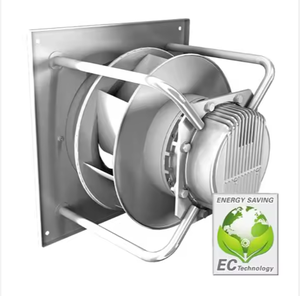
Electronically Commutated (EC) motors combine AC mains power input with internal permanent-magnet DC brushless driving. Offering energy savings up to 50% and compliance with European ErP efficiency standards, EC radial blowers are rapidly replacing legacy shaded-pole and induction motors across HVAC and industrial plants.
Modern industrial equipment demands real-time status reporting. Forward-looking buyers now specify radial fans equipped with 0-10V / PWM speed inputs, FG tachometer output signals, and RS485 Modbus communications to enable predictive maintenance and intelligent dynamic thermal management.
Off-the-shelf catalog products rarely fit compact modern machinery. Sourcing strategies are moving toward China manufacturers capable of offering rapid custom tooling, flexible wire harness assembly, short prototype turnarounds, and robust quality audit trails to mitigate global supply risks.
Our R&D team continuously invests in material science and fluid dynamics to deliver quieter, lighter, and more durable air movement solutions.
Using 3D Computational Fluid Dynamics (CFD) simulation tools, our design engineers analyze internal vortex formation and blade tip pressure losses within radial blower housings. By optimizing the trailing-edge serrations and tongue clearances of scroll casings, we achieve up to 4.5 dB(A) noise reduction without sacrificing static pressure output.
To support high-ambient industrial duties, our custom radial fans utilize dual NMB precision ceramic-hybrid or high-temperature ball bearings coupled with synthetic ester grease. Combined with high thermal conductivity aluminum motor housings, our fans achieve L10 life expectations exceeding 70,000 hours at 40°C continuous operation.
Get clear, authoritative answers from our senior engineering desk regarding custom manufacturing, quality testing, voltage parameters, and global delivery logistics.
An axial fan moves air parallel to the fan shaft (blade axis), producing high volumetric airflow at low static pressure. A radial fan (centrifugal blower) draws air in along the shaft and redirects it outward at 90 degrees using centrifugal force. This structural difference enables radial fans to overcome significant system static pressure caused by filters, ducts, and dense internal components.
Yes. We specialize in custom OEM engineering. We manufacture radial blowers operating at DC 5V, 12V, 24V, and 48V, as well as AC single-phase/three-phase (115V, 230V, 380V) and EC wide-voltage inputs. Control interfaces including 4-wire PWM speed regulation, FG tachometer frequency generation, automatic restart, and thermal sensors can be integrated into the harness assembly.
Our IP68 waterproof series uses a total vacuum-potting encapsulation method. The motor stator assembly and PCB driver board are completely sealed inside a high-thermal-conductivity epoxy resin within the motor casing. This prevents water immersion, chemical vapor ingress, and fine conductive dust from reaching electrical components, allowing continuous submerged or outdoor operation.
Every production batch undergoes 100% routine electrical testing (no-load current, starting voltage, dielectric hi-pot insulation), two-plane dynamic rotor balancing (ISO 1940 standard), static pressure vs. airflow verification in our AMCA 210 wind tunnel facility, and acoustic noise sampling in an anechoic chamber.
For standard modifications (custom lead wires, connectors, customized labels), MOQ starts at 500 units with lead times of 2 to 3 weeks. For completely new custom plastic impeller or housing tooling, prototype samples are delivered within 30 to 45 days, followed by series mass production upon client sample approval.