

Choosing the right Backward Curved Fans in 2026 requires more than comparing catalogue airflow and motor power. Global buyers must examine pressure stability, energy efficiency, noise levels, materials, controls, and after-sales support. A fan that performs well in a clean laboratory may struggle in a dusty factory. Real operating conditions matter.
Dr. Steven J. Hoff, a respected ventilation researcher, has expressed a practical principle: “Fan performance depends on the system, not the fan alone.” This idea should guide every purchasing decision. Buyers need to review the complete operating point, including airflow volume, static pressure, temperature, installation resistance, and expected running hours. Small details matter. A narrow duct, clogged filter, or poorly sealed housing can reduce actual performance.
This guide reviews leading Backward Curved Fans for international applications, including HVAC systems, industrial ventilation, data centers, and process equipment. It considers direct-drive and belt-drive designs, EC motors, corrosion-resistant coatings, vibration control, and remote monitoring. Certification and documentation also deserve attention, especially when equipment crosses borders. Yet no ranking can fit every project. That is the uncomfortable part. Product data may look precise, while site conditions remain uncertain. Buyers should request verified fan curves, test standards, warranty terms, and sample calculations before committing. The best choice is not always the most powerful model. It is the model that delivers stable performance, manageable operating costs, and dependable service in the buyer’s actual environment.
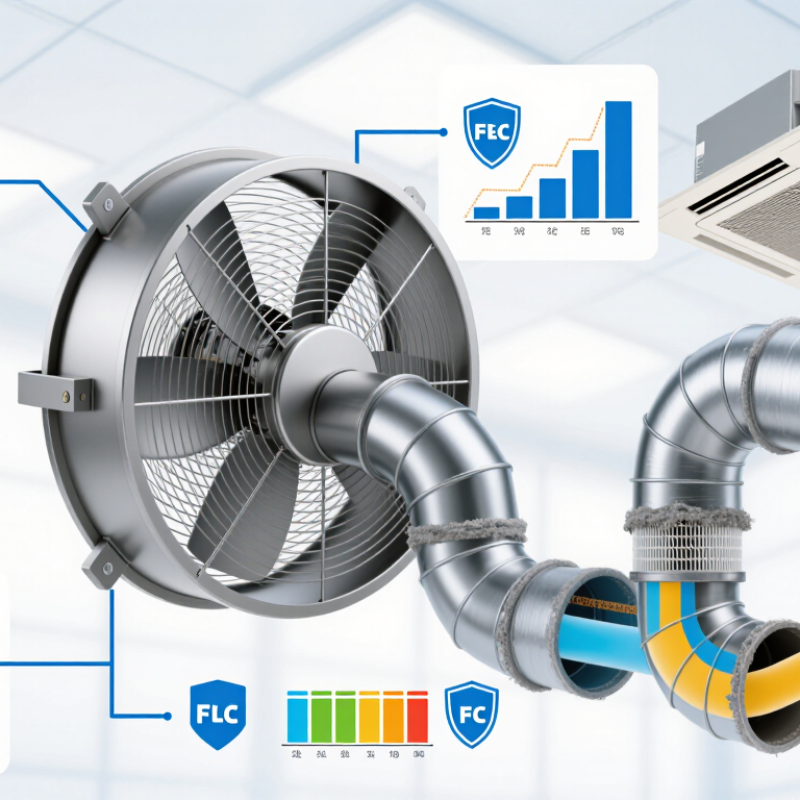
A backward-curved fan uses a rotating impeller whose blades lean away from the direction of rotation. Air enters near the center, then moves outward as the wheel spins. The curved blades guide it toward the outlet. Think of air sweeping across the wheel, not being scooped forward. The impeller’s shape helps convert rotational energy into airflow and pressure, making this design common in ventilation and air-handling systems.
The U.S. Department of Energy’s Improving Fan System Performance sourcebook describes the fan affinity laws: at constant air density, airflow changes in proportion to rotational speed, while power changes roughly with the cube of speed. A 10% speed increase can therefore mean about 33% more power demand. Small adjustments matter. In practice, the result also depends on system resistance, inlet conditions, and installation. A backward-curved fan may operate efficiently near its intended duty point, but poor duct layout or a clogged filter can shift that point. Measure airflow and pressure on site; a catalogue rating alone is not the whole story. The American Society of Heating, Refrigerating and Air-Conditioning Engineers’ ventilation guidance also emphasizes matching equipment to the required airflow and pressure, rather than selecting by size alone.
A high-performance backward curved fan begins with verified airflow and pressure, not a catalogue speed. Its impeller should deliver stable static pressure while resisting overload at changing system conditions. AMCA Publication 208 defines Fan Energy Index through airflow, pressure, and electrical input. That makes efficiency easier to compare across duty points. A higher FEI is useful, but only when tested at the required operating point.
Motor selection matters just as much. The U.S. Department of Energy’s 2022 Industrial Decarbonization Roadmap estimates industry uses about 26% of total U.S. energy. Fan losses can quietly increase that burden. Efficient motors, variable-speed drives, and accurate control signals reduce unnecessary operation. Keep the motor cool. Check the drive’s harmonic performance. Small details become expensive over thousands of hours.
Noise and vibration reveal construction quality. A balanced impeller, rigid housing, and properly sized bearings protect performance over time. ISO 13349 supports consistent fan terminology, while AMCA testing procedures help verify published results. On-site checks often find poor inlet clearance or a dirty filter behind unexpected noise. A polished efficiency figure can mislead. Real systems are rarely perfect. Allowing for fouling, voltage variation, and maintenance gaps produces a more honest selection.
Compare backward-curved fans by their operating point, not catalog airflow alone. Match required airflow and static pressure to the fan curve, then check efficiency near the expected duty point. A fan selected too close to its limit may struggle as filters load or duct resistance rises. Noise matters, too. Compare sound data under similar speeds and installation conditions.
For global applications, review supply voltage, frequency, motor enclosure, ambient temperature, and control method. Confirm that performance data reflects air conditions similar to your site. Check impeller material, corrosion protection, bearing arrangement, and cleaning access. These details matter in dusty plants and humid equipment rooms. Request dimensional drawings and test data; a polished brochure cannot answer every question. Also compare energy use, maintenance access, and replacement lead time. Some supplier figures may use different test conditions, so comparisons are not always straightforward.
Tips: Send suppliers your airflow, pressure, temperature, altitude, and duty cycle. Ask them to mark the proposed operating point on the fan curve. Check sound limits and motor compatibility with site requirements. Keep a reasonable performance margin, but avoid oversizing, which can waste energy. Recheck the selection if ductwork changes.
For 2026, the best backward curved fan is not simply the model with the highest airflow. International buyers should verify performance at the actual duty point, including volume flow, static pressure, speed, power, and sound. ISO 5801 provides standardized fan performance testing, while AMCA 210 supports reliable air-performance measurements. Ask for the complete test curve, not a single headline value.
Energy efficiency deserves close attention. The International Energy Agency’s Buildings report estimates that buildings consume about 30% of global final energy. Fan efficiency can therefore affect long-term operating costs, especially in ventilation systems running continuously. Check motor efficiency data under IEC 60034-30-1, and review variable-speed drive compatibility. Small gaps matter. A poorly matched motor may waste energy every hour.
Safety and market access require separate checks. Industrial installations may need IEC 60204-1, EMC testing under the IEC 61000 series, and verified protection ratings under IEC 60529. For household or similar equipment, IEC 60335-2-80 may apply. In Europe, CE marking indicates a conformity declaration, not independent approval. Also review RoHS, REACH, and local energy rules, including updated fan requirements. A certificate alone can still mislead. Test dates, product configuration, factory location, and rated conditions should match the offered fan. I have seen specifications change after quotation, so buyers should request signed datasheets and sample inspection records before ordering.
Selecting a backward curved fan starts with the system, not the catalog. Measure airflow, static pressure, air temperature, and duty cycle. Choose a fan near its efficient operating range. Oversized fans can waste energy and create unstable airflow. Check the impeller diameter, motor rating, casing material, and allowable speed. For international projects, confirm voltage, frequency, efficiency class, documentation, and local safety requirements. A tested performance curve is more useful than a promising product description.
Installation quality strongly affects performance. Keep the inlet and outlet paths clear. Follow the manufacturer’s recommended clearance around bends and dampers. Align the fan and motor carefully, then inspect flexible connections for unwanted tension. Before full operation, verify rotation, vibration, current draw, and unusual noise.
A small rubbing sound matters. It may become a costly failure. Technicians sometimes skip airflow verification after installation. That is a mistake worth reconsidering.
Tips: Record baseline readings during commissioning. Clean filters before pressure rises sharply. Inspect bearings, belts, fasteners, and insulation regularly. Remove dust from blades without bending them. Review vibration trends, not only sudden alarms. Maintenance intervals should reflect dust levels, humidity, temperature, and operating hours. In harsh environments, monthly checks may be wiser than a fixed annual schedule. The best choice is practical, measurable, and slightly conservative.
Match required airflow and static pressure to the fan curve. Check the expected duty point, not catalog airflow alone. Include temperature, altitude, air density, and duty cycle. The real system may differ.
Efficiency depends on where the fan operates. A fan near its limit may struggle when filters become dirty. Rising duct resistance can reduce airflow and increase energy use. Leave a sensible margin.
Compare fan energy index values at the required operating point. Check airflow, pressure, and electrical input together. Different test conditions can make supplier figures misleading. The comparison is not always perfect.
Efficient motors reduce losses during long operating hours. Variable-speed control can match output to changing demand. Use accurate control signals and check drive harmonics. Small losses become costly.
Confirm voltage, frequency, motor enclosure, and control compatibility. Check whether the motor suits the site temperature. Review electrical requirements before ordering. Do not assume compatibility.
A balanced impeller helps limit vibration. A rigid housing supports stable operation. Correctly sized bearings protect performance over time. Unexpected noise may indicate poor inlet clearance or dirty filters.
Review impeller material and corrosion protection. Check bearing arrangement and cleaning access. Dust can collect on blades like a thin gray coat. Humidity may accelerate corrosion.
Request dimensional drawings, fan curves, sound data, and test results. Ask suppliers to mark the proposed operating point. Review maintenance access and replacement lead time. A polished brochure is not enough.
Backward Curved Fans are designed to move air efficiently by using blades that curve away from the direction of rotation. This geometry helps manage airflow and pressure while supporting stable operation in many ventilation and air-handling systems. When assessing performance, buyers should consider factors such as airflow capacity, static pressure, energy use, noise, materials, operating temperature, and compatibility with the intended system.
Comparing fans for international applications also means checking whether their performance data is clearly documented and whether relevant standards and certifications suit the project’s location and requirements. The right choice depends on the operating conditions, installation space, control needs, and expected duty cycle. Proper system sizing, careful installation, and routine inspection can help maintain reliable performance over time. By evaluating technical specifications, compliance documentation, and maintenance needs together, buyers can select a fan that fits both their application and long-term operating goals.